The lessons one learns on the Camino span the gamut of complex, soul-deep lessons that take years to unpack and obvious ones like learning to be careful about how much stuff you carry in your pack. You tend to take a rain jacket and one change of clothes, the shoes you walk in, and sandals for at night. It’s amazing how simple a packing routine can get when you realize that you have to carry every bit of luggage on your back, but I think even the most seasoned pilgrim that I met while walking the Camino de Santiago de Compostela would be shocked to find someone who followed Jesus’ instructions to the disciples in our gospel lesson today: feet in bare sandals and only one tunic with no money or bread to get them through.
Mark tells us that when Jesus returns to his hometown, he faces fierce rejection. Jesus then calls the disciples together and sends them out in pairs, giving them authority over unclean spirits, but instructs them to carry nothing: sandals and one tunic, so that they could heal folks and accept hospitality of strangers along the way. And if folks don’t offer hospitality to someone with literally nothing? They were to shake the dust of that town off their feet and move along to the next place.
When I hear Mark’s account of this story, I wonder what the disciples thought when Jesus’ hometown folks started to push against him, and what they thought when Jesus’ bare-minimum instructions were given about dust shaking. I wonder what the people in Nazareth thought, not just about Jesus coming home, but about the disciples who followed him, and about the healing acts he did do. And I wonder if Jesus was a little bit worried that the disciples would hear his instructions about no money, no bread, no extra clothes, and would abandon the cause, because in all truth, this might be where I would have struggled to continue the journey.
Because it’s important to remember that Jesus doesn’t send the disciples out after a big meal, or a fancy reception, rather, he sent them out after he was rejected by the people who knew him since he was a small child. And in this, Jesus literally showed them what it looks like to face cruel rejection, to shake the dust off your feet, and move on, all the while continuing to rely on the hospitality of strangers. Jesus knows that God calls disciples – that God calls us – to uncomfortable places, and Christ set the stage for the disciples directly before they are sent out, equipping them to become comfortable in the discomfort.
I wonder if when we collectively hear this gospel account read, who we imagine our church being? Do we see ourselves as the disciples, being tasked to go out into the world to share the Good News of God in Christ? I hope so, discipleship is complex and a lifelong journey, and we can only do it together.
But I also hope, maybe in a bizarre way, that we can see ourselves as the group who hurled critiques and questions and mocked the Christ? Not because I see that who we are, but because my friends, we will mess up; we will get it wrong, and if the account of the gospel of Jesus Christ only ever makes us feel comfortable, then maybe we’ve molded and shaped the gospel to our own preferences.
It is vital, I believe, to remember that God calls us to uncomfortable places. Sometimes that means that we acknowledge where we were wrong, where we have room to grow, where we can do better at following Jesus. There will be times when we are like the disciples, going out to do the work we have been given to do, times when we will go to uncomfortable places and receive radical hospitality of those who are different than us, and times when we must shake the dust off our feet and move on. And, unfortunately, there will be times when it is our own words, our own actions, our own beliefs that create the uncomfortable places for those God loves deeply.
This past year, I took part in a course called Sacred Ground from the Episcopal Church, taught at our church by Shelley Carter and Deacon Kellie. over those weeks, I was called to some uncomfortable places. Learning, not for the first time, but in much greater and sharper detail, of the horrors imposed upon the Indigenous Peoples of this land, our learning circle heard stories from families who were ripped apart while children were forced into residential schools run by The Episcopal Church; the children were not just denied their culture, but many faced abuse and death. At General Convention two weeks ago, the House of Deputies voted to express remorse for the irreparable harm caused by this and received the A Prayer To Remember The Innocents, written by Indigenous communities in South Dakota, in it they pray:
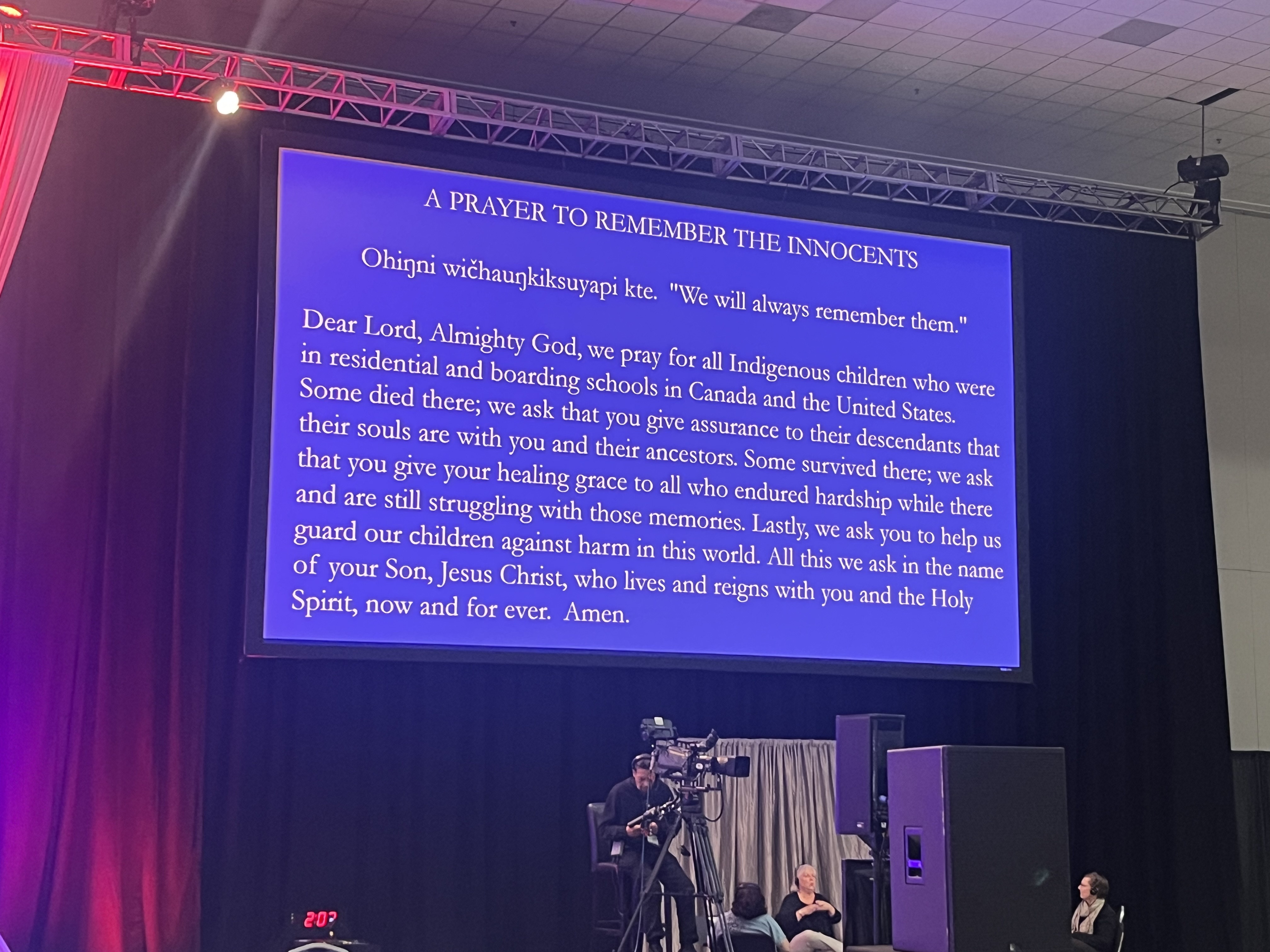
A PRAYER TO REMEMBER THE INNOCENTS[1]
Ohiŋni wičhauŋkiksuyapi kte. “We will always remember them.”
Dear Lord, Almighty God, we pray for all Indigenous children who were in residential and boarding schools in Canada and the United States. Some died there; we ask that you give assurance to their descendants that their souls are with you and their ancestors. Some survived there; we ask that you give your healing grace to all who endured hardship while there and are still struggling with those memories. Lastly, we ask you to help us guard our children against harm in this world. All this we ask in the name of your Son, Jesus Christ, who lives and reigns with you and the Holy Spirit, now and for ever. Amen.
Friends, when we follow Christ, we follow Christ to the dusty, uncomfortable spaces where we may be rejected. We follow Christ to the places where we have to acknowledge that we have been the cause of harm and hurt. When we follow Christ, we are called to share the Good News of God in Christ, and I genuinely and fully believe that it is good news, but not a single bone in my body believes that it is easy news. It requires us to go to uncomfortable spaces, it requires us to lean into hospitality from strangers, it requires us to name, confess, and repent of our sins, collective and individual. And, I can’t tell you what this will look like, but I know that to share the Good News of God in Christ, we must not fool ourselves into thinking that we will always get it right. Rather, it is our task, the task of our faith, to answer God’s call to uncomfortable places and to go out as Jesus commanded. We must be willing to admit where we get it wrong in order to do better at getting it right. And it is my prayer that today that we will be willing to be vulnerable enough to be rejected like Christ, that we will be able to see the opportunities to go out into this world like the disciples, and that we will have the courage to answer God’s call to those uncomfortable places, no matter how dusty they may be. Lord in your mercy, hear our prayer.
[1] https://www.vbinder.net/resolutions/684?house=HD&lang=en
A sermon delivered to the people of Christ Episcopal Church in Bowling Green, Kentucky on July 7, 2024 for Proper9B on Mark 6:1-13.


Leave a Reply