
Maybe I’m projecting my own awkwardness on all of you, but I’m keenly aware of two things this morning. First, I’ve stolen the opening line from last week’s sermon. Preaching about Mark’s account of Jesus’ diatribe on divorce is no easy task, and I am grateful for Father Steve’s skill in preaching the truth that though divorce is so incredibly hard, that God is still here. And second, despite my desire to preach a gentle sermon today, Mark the evangelist continues his account of Jesus’ insistence on ethically standards that make the disciples do a double take and so instead, today we hear about how Jesus tell the rich young man to go and sell all his possessions and give his money to the poor. Oh, and it’s easier for a camel to pass through the eye of a needle than for a rich man to enter into heaven. Easy-peasy, lemon squeezy, thank you, Mark.
One of the books that I return to year after year each Autumn is Pema Chodron’s When Things Fall Apart. Chodron, a Buddhist nun, is known for her tender, brilliant, and piercing writing on the Buddhist philosophy of non-attachment. Recently, in reading it, I noticed an underlined passage from a previous reading with the word “oof” written in the margins: “The most fundamental aggression to ourselves, the most fundamental harm we can do to ourselves, is to remain ignorant by not having the courage and the respect to look at ourselves honestly and gently.”[1] And when I think about today’s difficult passage, I think she’s so right; it takes courage and respect to look at ourselves honestly and gently.
I wonder if the rich young man looked at himself with gentle courage. He had lived a good life, but because he wanted to be sure of his salvation, and he came, knelt before Christ, and asked him what he needed to do to inherit eternal life. Clearly this is a man of great faith and trust in Jesus. Christ responded to him with the basic commandments: no murder, adultery, stealing, lying, or fraud, plus honor your parents. In his eagerness, the rich man said that he had kept the commandments, and Jesus sees him, gently and honestly sees him, and loves him, Mark tells us.
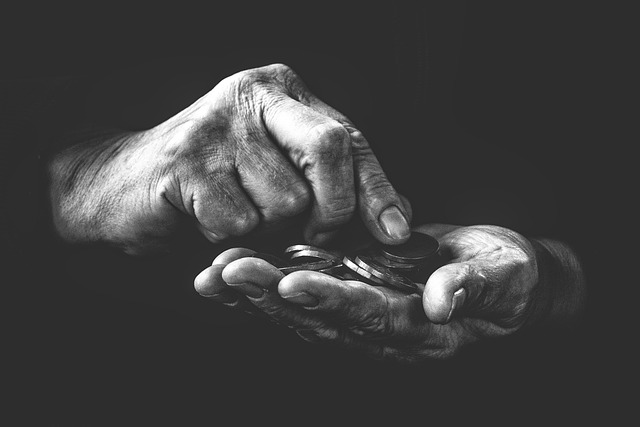
And in this love, Jesus names the one thing he lacks to inherit eternal life. Jesus tells him to sell all that he has, give the money to the poor, and then to come and follow him. Shocked, he went away grieving. He’s so willing to do anything, and yet when he’s told to give away his financial gain, he walks away. He’s so close to the kingdom of God, but when told what one thing stands between him and God’s kingdom, he walks away grieving. Oof.
The unfortunate truth of this passage is that this story about the rich man who comes to Jesus is so often used to guilt or shame church folk into giving more money to the church, even though that’s not what Jesus is saying. The rich man lacked unbridled generosity with his financial means to the poor. And it makes me wonder, part of the rich young man struggled with was his capacity to courageously and gently see himself and see what he lacked, even though it seemed like he had it all.
Which makes me wonder what am I not courageous and self-respecting enough to really ask myself about what I lack when it comes to this life of faith? I wonder what would be hard to give up in effort lean toward God? What parts of my life do I need to have courage to see honestly and gently? What do I need to give away to have access to God’s kingdom?
There have been hundreds of interpretations of what Christ meant when he said to this man, give it all away, and I truly think it’s a lot simpler than what many folks have thought. I think when Christ says it’s easier for a camel to go through an eye of a needle than it is for someone who is rich to enter the kingdom of God, what Christ means is that money does not a good Christian make. In fact, wealth can be a hinderance to experiencing the kingdom of God. Because the kingdom of God requires us to give it all away; the kingdom of God is one wherein which radical, unbridled generosity is the ruling idea.
With courage and respect, when you look at your own life gently and honestly, what do you see? Where do you see gaps between the kingdom of God in which all people are truly valued the way that you live your life. We all have these gaps, I promise you, we do. It may not be wealth for you, but I know that it’s something; we are all lacking in something. Each of us has something that holds us back from experiencing the fullness of God’s love.
Maybe it is wealth; maybe it’s the idea that you and your family need a safety net that comes at the cost of others hitting rock bottom. Maybe it’s fear; maybe it’s this idea that you need to live a life that’s safe and comfortable before living into the kingdom of God. Maybe it is control; maybe what you need to give away is the illusion of control over your life by asking God’s guidance and direction. Maybe it’s a bunch of little things that add up to something that feels immovable, but I promise it’s not, because for God all things are possible. Whether it’s your wealth, your fear, your need for control or something entirely else, whatever the thing is that stands in the way of you experiencing the fulness of God’s kingdom, give it away. Give it all away. Give it away with courage, looking gently and honestly at yourself, and trusting that with God all things are possible.
[1] Chodron, Pema. When Things Fall Apart. 31.
This sermon was preached to the people of Christ Episcopal Church in Bowling Green, KY on Mark 10:17-31 for Proper 23B on October 13, 2024.

 Becca Kello